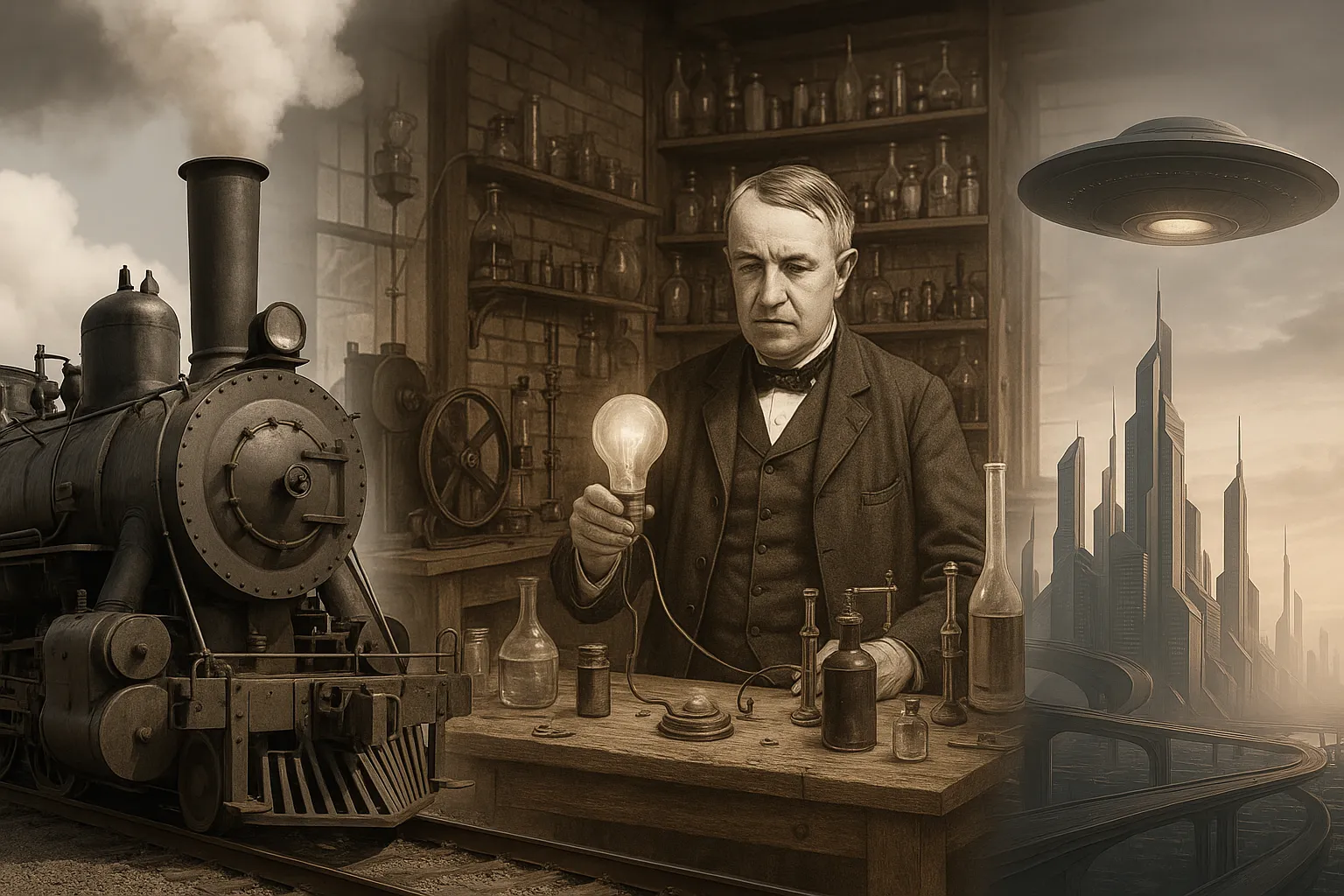
Early-stage startups show us that successful future tech depends on timing, adaptability, and the ability to build on proven innovation patterns.
Even when 90% of startups fail within their first five years, the lessons behind successful startup innovation breakthroughs stay surprisingly consistent. A lot of people in the tech world love to talk about overnight success, but real innovation usually follows clear patterns. And those patterns are easily learnable.
In this article, you’ll get a clear look at how early-stage startups follow those ideas to survive the chaotic markets. You’ll also see what these young companies get right, what they struggle with, and how their decisions hint at the direction of innovations.
Let’s take a look at how tech companies today repeat the innovation patterns from three centuries back.
How Early Startups Follow the Same Patterns as Historical Breakthroughs
Innovation works the same way when you’re launching a SaaS product or inventing the steam engine. And breakthroughs come from people building on existing ideas at the right time, rather than from isolated geniuses working alone.
Like for example, Newton built on Galileo and Kepler’s work. Or Edison’s lab ran like a modern startup with specialized teams. And early computer artists created groundbreaking art on primitive machines by thinking differently about what technology could do.
The successful founders throughout history all shared a common pattern. Which is their environment and circumstances supported their work at just the right moment. All the necessary knowledge was available, the infrastructure was growing, and the world was ready for what they wanted to build (yes, it’s like fate did half the work).
But don’t give up hope, thinking “it’s just luck anyway.” As a modern startup, you gain a huge benefit when you recognize these patterns. It becomes easier to see when conditions support a breakthrough and when it’s smarter to adapt.
It’s because history keeps repeating the same truth: timing often beats talent. Even the most innovative idea will fall if the ecosystem isn’t ready for it.

The Earliest Instance of Disruption: Steam Engines
Steam engines are one of the clearest examples of how disruption actually works. The core technology for steam engines actually existed long before it became mainstream. It took years of trial, error, and social adaptation before steam became part of everyday life.
And that’s exactly what most modern founders miss. Change doesn’t come in a single launch. Instead, it builds slowly, as systems, people, and industries learn to adjust.
Here’s a short look at how innovations have always followed similar patterns
The Ripple Effects of Steam Power
The fascinating part about steam power is the ripple effects it created, rather than the machine itself. As soon as factories no longer needed to be built by rivers, cities rebuilt themselves to support newer industrial growth.
Even the railroads forced countries to create standardized time zones because trains finally needed synchronized schedules. These secondary effects ended up being far more significant than the original invention.
And this effect spanned over generations. Steam’s story is a lesson that even the most world-changing innovations take time to show their full impact.
What Most Founders Get Wrong About This Era
Founders tend to focus on the invention itself rather than the supporting systems that made the widespread adoption possible.
For example, infrastructure, like coal distribution networks and trained engineers, was more relevant than the machine design improvements themselves. It shows why founders must create the right surroundings for their product, not just the product itself.
Thomas Edison’s Real Secret
Ever wonder why Thomas Edison succeeded when hundreds of other inventors tried and failed at the same problems?Edison tested thousands of materials for light bulb filaments, and treated each failure as data rather than defeat.
His Menlo Park lab ran like a modern startup with specialized teams repeating quickly on multiple projects. The system Thomas Edison created was far from making one brilliant invention. Instead, he wanted a machine that could produce innovation repeatedly.
Because of that, the phonograph, motion pictures, and practical electricity all came from his systematic experimentation and improvement.
Thomas Edison understood something most entrepreneurs miss today. And that is, success in innovation comes from creating the right conditions for breakthrough ideas to develop.

Can Science Fiction Predict What’s Next?
Science fiction has a long history of predicting future technology before it becomes reality. Writers have predicted smartphones, satellites, and virtual reality decades before engineers made them real.
Based on our research into emerging technologies, writers like Arthur C. Clarke and Isaac Asimov accurately predicted satellites, tablets, and AI decades before engineers built them. And founders who study these stories gain insight into where technology might head next.
Let’s take a look at some of these interesting details.
Authors Who Predicted Tomorrow’s Technology
Some writers were very specific about future technology that engineers later admitted using their books as blueprints. Their visionary ideas helped create real-world innovations and inspired technological progress. For instance,
- Extra-Terrestrial Relays: Clarke saw the writing on the wall for satellite communications and described them in 1945, fourteen years before the first one launched into orbit successfully.
- Star Trek: Another example is how Star Trek’s communicators directly inspired Motorola engineers when they designed the first mobile phones in the 1970s.
- Star Wars: Star Wars also showed us what advanced computers and artificial intelligence might look like in everyday life.
- Snow Crash: Neal Stephenson’s Snow Crash outlined virtual worlds that companies explicitly referenced when building their digital platforms.
All these authors were just being creative, but they were also unintentionally drafting the early playbook for future innovators.
Now that you’ve seen how authors predicted tech, here’s why their approach can be useful for your startup.
Big Vision Trumps Cutting Edge Tools Every Time
A great example is how early computer artists like Vera Molnar created generative art on primitive machines by thinking algorithmically first (primitive by today’s standards, brilliant by any measure).
They didn’t wait for better technology. Instead, they played with simple geometric patterns and variations. And the art they created made history using basic computers and simple systems.
Modern founders often delay launching until tools are perfect. And that’s how they miss opportunities to innovate with what exists now. They don’t understand that cutting-edge technology is less necessary than creative thinking and timing.
What Should You Watch For Before Everyone Else Does?

Recognizing when the time and conditions are right before your competitors do gives you a huge advantage in timing your launch.
This means looking beyond individual talent to check out the infrastructure, community readiness, and other complementary technologies that can push your success. This is how you can stay ahead of your competitors.
Spotting When Conditions Are Right
Keep an eye out for clear signals that the market is ready for your idea. When multiple teams are working on similar problems, it’s a sign the ecosystem is waiting for a breakthrough.
When supporting technologies mature simultaneously, they create unexpected combinations that weren’t possible years earlier. And the build-out of infrastructure usually means the market is gearing up for change.
Standing on Shoulders Works for Startups Too
The fastest way to innovate is by understanding what already exists in your field and building on it. Research shows patterns emerge when you look at how knowledge builds over time.
We’ve mentioned how Newton built on Galileo and Kepler. He took notes of Galileo’s observations and Kepler’s laws of planetary motion to formulate his laws of motion and universal gravitation. Basically, he didn’t build everything on his own.
That’s how every breakthrough depends on prior work that built the foundations. And founders who study their field’s history can avoid repeating mistakes.
Timing Almost Always Beats Talent
You could have the best team and perfect execution, but if you launch at the wrong time, you’ll still fail (harsh truth, but there it is).
We’ve seen brilliant ideas that launched too early fail because the market isn’t ready or the infrastructure doesn’t exist yet. The same idea introduced five years later succeeds because circumstances changed, not because execution improved dramatically.
Time to Apply These Patterns to Your Startup
History teaches us that innovation is often less about individual genius and more about being ready at the perfect timing.
The technology you’re working on today follows the same principles that guided the rise of steam engines, Edison’s methodical invention process, and the visionary predictions of science fiction. That’s exactly why understanding historical patterns can influence a startup that thrives.
So, to spot the right moment, pay attention to signals like multiple companies tackling similar challenges. These clues are more valuable than having the flashiest or newest solution.
And if you want to stay ahead of the curve and learn more about emerging tech and innovation patterns, check out The Demo Blog.